The man in the toga
Rome, 150 BC, the Senate is in session, and Marcus Porcius Cato, an established and bold politician, rises to speak. He gives the folds of his toga a little shake, and out drops a stick of RAM. A brand new 512GB RDIMM, still in the anti-static package. The senators lean in for a better look. Where did he find RAM like that?
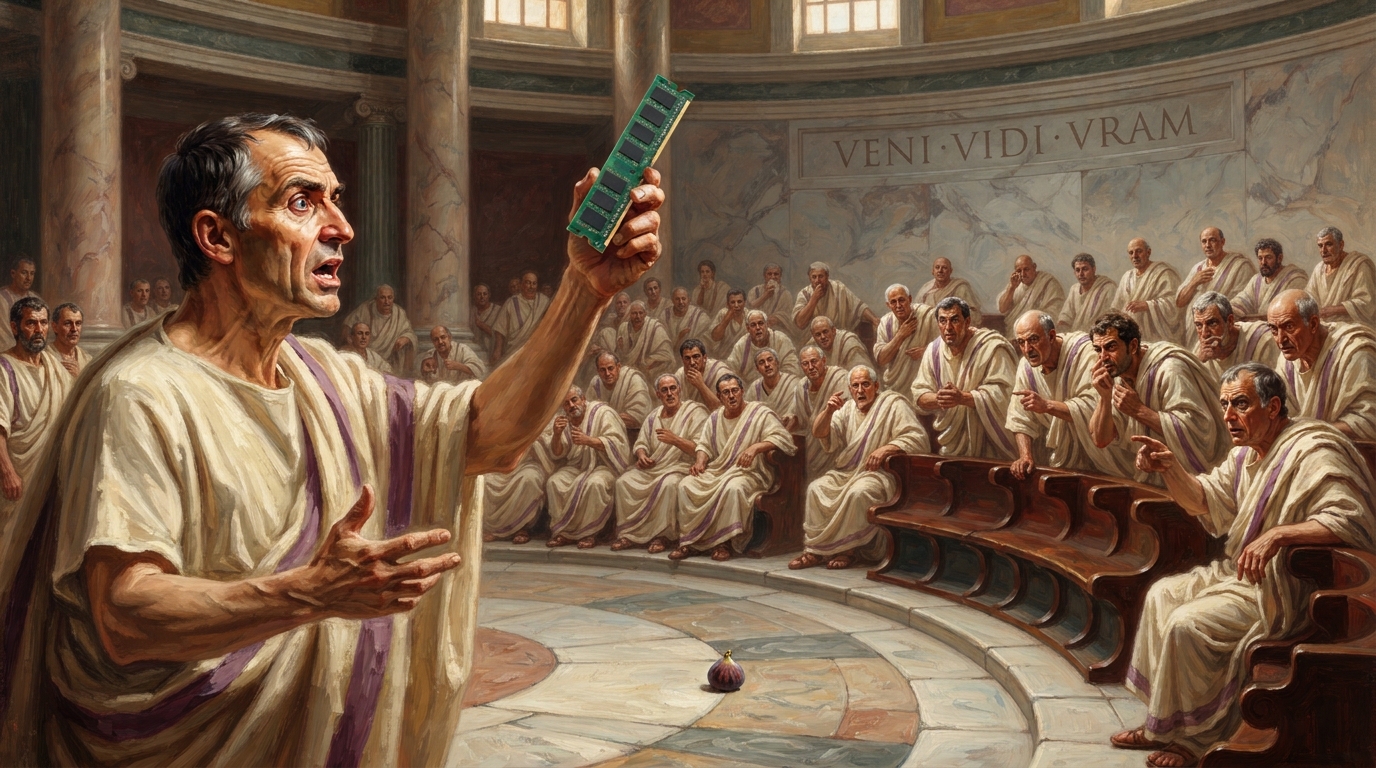
(Image generated with Gemini AI)
"Three blocks away," Cato tells them. It's destined for a datacenter in Carthage, which is just a short walk from everyone's homes, their children's schools, their local grocery stores. The crowd gasps. Our quiet subdivision! Our precious water! There's only one solution. WAR! Attack the datacenters before they destroy our way of life! Half the Senate jumps to its feet in thunderous applause.
Then a second senator leaps up, Scipio Nasica, a well-connected and astute politician in his own right. "Fools! If we don't build datacenters, our rivals across the sea will!" The other half of the Senate roars. The crowd, now somehow simultaneously terrified of having datacenters and of not having datacenters, bursts into fiery argument.
Cato and Nasica sit back down. Neither proposal will pass, but both of them have gotten exactly what they wanted from the crowd.
What just happened
Of course, it wasn't RAM, it was a fig. A big ripe one, and according to Pliny the Elder, Cato claimed it had been picked in Carthage just two days earlier. Carthage was three days' sail from Rome, not three blocks. And that freshly picked Carthage fig, not dried out or rotten, was a great prop for selling the claim that a deadly threat was right on their doorstep. Cato tacked the same line onto every vote he cast, on any question at all: "Carthage must be destroyed." And Scipio Nasica ended his speeches with "Carthage must be spared." Not out of kindness, though. Plutarch tells us Nasica wanted Rome to keep fearing Carthage, "to curb the boldness of the multitude like a bridle." Two senators on opposite sides, but both using the same fear as a tool to manipulate the masses. Oh, and it was an election year. Starting to sound familiar?
(And just to set the historical record straight, Cato did eventually get his war, but that's another story, and this is just a metaphor.)
Fast forward a couple thousand years to the US midterms that recently wrapped up. More than half of voters told the networks' exit poll that AI and datacenters were a crucial or major factor in how they voted. In September, Pew reported that for the first time, people in one party were noticeably more worried about AI taking jobs than people in the other. On election night, voters who thought AI would help society broke roughly 60/40 for one party, and voters who thought it would hurt broke closer to 65/35 for the other. And once again, an issue that affects everyone has become a political divide. (Remember global warming? How did the politicization of that issue work out for us? Lots of bluster, lots of money, lots of voting, lots of blame, and decades later we're still having the exact same argument.)
So we get to see this age-old failure mode happen yet again in real time. Not long ago, AI wasn't a partisan issue at all. The bill to make companies report AI-driven layoffs had sponsors from both parties. Majorities in both parties supported pausing datacenter construction for at least a year. People on both sides were worried about the same things. Now that worry is being sorted into teams, and once it's sorted, it's a lot easier to use to garner votes, and a lot harder to actually solve.
Even the AI industry can feel it. Its super PACs, on both sides of the regulation fight, spent more than $50 million on the midterms, and their ads mostly avoided mentioning AI at all. When the people selling it won't say its name, you know the word has become radioactive.
What DC does next
So when the 120th US Congress is sworn in on January 3, 2027, what will it do about AI? Any real solution to AI-driven job loss is going to take a lot of lawmaking, and at Washington DC speed, that means years of hearings, studies, committees, and compromise. Compromise in particular has been in pretty short supply in DC for a long time now, and an issue both parties have already staked out as campaign territory isn't going to change that.
So in lieu of a real solution, here's my prediction. Congress will reach for quick, brute-force fixes, and the biggest, simplest, and loudest of them will be a bill that makes it difficult, or even outright illegal, to lay someone off and replace them with AI.
Nothing quite like that has been proposed in Congress yet, but the idea is already in the air. New York already bars its own government agencies from replacing employees with AI, and bills in New York and New Jersey would make AI-driven layoffs slower and more expensive. The week after the midterms, a senator in the Philippines announced a bill that would make companies give the government six months' notice before any AI-driven layoff, try retraining first, and pay double the usual severance. So far, the AI jobs bills in Congress have been about disclosure (making companies report AI-related layoffs), safety nets, and taxes, and a couple of them even have sponsors from both parties. But a layoff ban checks every box a campaign could want. It's simple, it fits in a headline, and the average voter, already nervous about AI and worried about their job, will love it. Within days of the election, some prominent members of the incoming majority were already calling for a national moratorium on new datacenters. The layoff ban will be the same move, aimed at a much bigger crowd.
Will it pass? No. Not with Congress and the White House on opposite sides of the issue, and without the two-thirds majority in both chambers it takes to override a veto. But passing isn't the point. There's even a name for this kind of thing: a "messaging bill," one introduced not to become law but to put the other side on the record. Both parties have been doing it forever, and every vote against it becomes a campaign ad. Senator So-and-So voted to let the robots take your job.
And the other side won't sit quietly, either. Expect veto threats delivered as loudly as possible, since a promised veto makes just as good a campaign ad as the bill does, and expect the counter-messaging right on schedule: the ban is a job killer, it'll drive companies overseas, and if we don't build AI, our rivals across the sea will. (Nasica would be proud.) All of it will play out on the biggest stage there is, on every network, every feed, and every news cycle from now until the next presidential election. Because that's the real prize here: November 2028.
Why it wouldn't work anyway
Let's say one of these bills did somehow pass. Would it save anybody's job? Probably not.
First, it would change the vocabulary of layoffs, not the layoffs. Right now, plenty of companies practically brag about AI-driven cuts, because it makes them sound cutting-edge to investors. There's even a name for blaming AI for cuts that had nothing to do with it: "AI washing." Make AI layoffs illegal, and the word "AI" will vanish from every layoff announcement in America overnight. It'll all be "restructuring" and "realignment" again. Employers will blame "market downturns" and "economic headwinds." The layoffs will happen anyway, but we'll lose what little information we had about why. And thus, a law meant to protect workers from AI will end up hiding what AI is doing to them.
Second, the automation would just move from firing to not hiring. You can't lay someone off and replace them with AI if you never hire them in the first place. Hiring freezes, attrition, jobs that quietly never get posted. Nobody gets a pink slip, so nobody gets a press conference. The burden would shift from people who have jobs, who are visible and anxious and vote, to people looking for one, and early research suggests this wave is already hitting entry-level workers hardest.
Underneath both of those is the real problem. Earlier this year, Brett Hemenway Falk of the University of Pennsylvania and Gerry Tsoukalas of Boston University published a paper called The AI Layoff Trap. It explains why companies keep automating even when they can see it hurting everyone, themselves included. A company that automates keeps all of the savings for itself, but the cost (fewer paychecks, so fewer customers) gets spread across all of its competitors. So even when every company can see the cliff coming, none of them can afford to be the one that holds back. In the authors' words, "knowing this is not enough for firms to stop it." They use a lot more math to get there, but the introduction and discussion are accessible to all. A layoff ban doesn't touch that incentive. It locks one door, and the incentive walks out through another.
Why that doesn't matter
None of that matters, of course, because nobody expects any such bills to pass. They'll be written anyway, but as I pointed out above, they won't be intended to actually fix anything, they'll only be written to be seen.
And that's what worries me. Not the bills themselves, the two years of intense political drama that will come with them. Every hearing, every vote, and every press conference will get chewed over by pundits, commentators, and politicians on every channel and every feed, from now until November 2028. Thousands of hours of talking heads, and very little of it will explain how any of this actually works. The public won't see anything resembling actual education on the issue, just senators waving their figs at each other.
We're all wired for this, me included. Drama and conflict grab our attention, and calm explanations don't. (Case in point: I opened this article with a guy dropping RAM out of his toga.) But feed people a steady diet of fear for two years, and they won't come out of it calm, rational, or well informed. They'll come out of it polarized and angry, and ready to believe the worst about AI, or about whoever's on the other side of the issue. And most of all, chomping at the bit to vote those bad guys out of office! We're not in the realm of facts and logic and calm, rational thinking here. We're in the realm of politics, and the name of that game is votes.
What the bumps look like for business and tech
So what does a bumpy ride look like if you're running a business, or building one, that leans on AI? Here's what I'd watch for.
AI goes quiet. Companies won't stop using AI. They'll stop talking about it. Announcing a big AI initiative is about to become a reputational risk, the kind of thing that ends up in a campaign ad or a viral post. Remember those super PACs that wouldn't say "AI"? Expect press releases to follow their lead.
The datacenter down the street. This is the one fear that crosses party lines. Within about a week of the election, prominent members of both parties were calling for a national moratorium on new datacenters. In exit polls, about three out of four voters, including a majority in both parties, said they'd oppose a new datacenter in their own community, and at least ten incoming governors have vowed moratoriums or new restrictions. If your plans depend on new capacity getting built somewhere specific, expect delays, fights, and lawsuits.
State-level surprises. Congress can't get past a veto. A state where one party runs both the legislature and the governor's office can. Most of this theater will stay theater, but a few of the actors might surprise us, and a patchwork of fifty different sets of state rules would be its own kind of bump.
Market whiplash. Within days of the election, the Nasdaq fell more than 5% in a single day, partly as investors worried about what the results meant for datacenter construction. Add two years of bubble talk, and every hearing will become a market event, with a lot of retirement accounts along for the ride. I have no idea when this bubble will pop, what it will really look like, or if this even qualifies as a "bubble" in the first place. But the stock market will feel the bumps.
The debt ceiling. The federal government is expected to hit its legal borrowing limit sometime in 2027, with the White House and Congress on opposite sides. The US isn't going to simply default on its debt. The only realistic way that happens is if politicians choose to, in a standoff exactly like that one.
Your own people. Your employees and customers read the same headlines everyone else does. Some will be scared, some will be angry, some will be both. A few might see some unique opportunities too. In any case, expect harder questions about how AI is being used at your company, and have honest answers ready.
AI isn't going anywhere
So with all this political theater swirling around, will any of it actually slow AI down? No, not even a little. And the reason has nothing to do with lobbyists or anyone's master plan. AI is locked in place in a few different ways.
First, companies can't stop. That's the Layoff Trap from earlier: every company can see the cliff coming, and none of them can afford to be the one that holds back.
Second, the economy can't afford to stop. By many estimates, AI investment has been driving somewhere between a third and half of all US economic growth over the last year or so, depending on whether you count all the imported chips. And AI-linked stocks now make up, by some counts, nearly half of the entire S&P 500, the most concentrated the market has been around a single theme since the railroads. Now guess what's sitting in tens of millions of 401(k) accounts. Every voter with a 401(k) is an AI investor, whether they know it or not.
Then there's the national debt, north of $40 trillion. In the fiscal year that just ended, the US paid over a trillion dollars in interest on it, more than it spent on the entire military. There are only a few ways out of a hole like that, and growth is the only one that doesn't hurt. Right now, AI is the growth.
Is it wise to pin this much of the economy on one technology living up to its promises? Nope. I'll say that plainly. But wise or not, that's where the US is now, and blaming the other guys for getting it there won't get it out. Both parties had a hand in building this teetering tower. Do not trust your chosen political party to focus on actual, pragmatic solutions either, no matter what they promise you. They want votes, and the real (unfortunately somewhat painful) solutions to serious US economic issues won't get them.
This is the part that matters for the next two years, the politicians won't stop it. They'll shout at it, hold hearings, introduce bills, and wave the RAM around the Senate floor. But the US economy is relying on AI so heavily right now, it can't be shut down. And no political party wants to be responsible for pulling out the last Jenga block that collapses the whole thing. So they won't. They'll make a lot of noise, but they won't put the brakes on AI in any meaningful way.
"But what about the AI bubble?" There'll be turmoil for sure. But ask most people what happens when the AI bubble bursts, and they'll probably tell you that's when AI goes away. That's not how bubbles work. When the dot-com bubble burst in 2000, Amazon's stock lost more than 90% of its value and Pets.com went to zero, but the internet didn't go anywhere. The telecoms had laid so much fiber-optic cable that most of it sat dark in the ground, and a few years later that cheap leftover capacity became the backbone of the broadband era. The railroads went through more than one spectacular crash in the 1800s, too, and they still built the US. A crash hits the investors. The infrastructure stays, and somebody buys it for pennies on the dollar and builds the next thing on it.
And if anyone out there knows of another engine that can supply a third of US economic growth next year, I'd love to hear about it. Seriously, tell me.
In Closing
If you're reading this and feeling a bit powerless to avert the AI tidal wave that's going to sweep over us, that's because you are. Complaining won't prevent it. Voting won't prevent it, because as we've seen, neither party can afford to. Ignoring it certainly won't prevent it. There's nothing you can do as a typical citizen to prevent any of this from happening.
So focus on what you can do: prepare. Learn everything you can about AI, its capabilities, strengths, and weaknesses. If you're a fan of AI, this shouldn't be hard. If you're opposed to AI, then consider the age-old adage, "know thy enemy." The second worst thing you can do is passively accept it, or resist it only by complaining on social media and waiting for the next election. The worst thing you can do, whichever side you're on, is resort to some sort of violence or sabotage, that's just handing your opponents everything they need to discredit you and your cause.
If you're pro-AI, ask yourself, have you taken the time to truly understand the objections some are raising, or are you just shutting them out? And the next time you hear yourself say "if we don't build it, our rivals will," ask whether that's an argument, or just Nasica waving his fig. With the AI revolution at hand, it's more important than ever that we humans appreciate what it is that makes us human. AI could materially impact a lot of people in a negative way if we don't navigate this revolution with patience and mutual understanding. Don't dismiss others' concerns out of hand, they can be addressed without hindering the plans you have for AI.
And for the anti-AI camp, ask yourself, is it artificial intelligence itself you oppose, or is it people abusing and greedily profiting from AI that concerns you? Opposed to rapid and ecologically unsustainable datacenter buildout? That's corporate boards and executives racing to become the kings of the AI hill and enjoy the spoils, which stems from human desire, not AI. Concerned about people losing their jobs? The hard truth is, yes, people are going to lose their jobs to AI, a lot of people. Don't fight the inevitable, work toward a post-labor economy that provides the population with what they need in a world where people don't have to work as hard as they used to. Worried about the rights of artists and content creators? There are a lot of laws already in place for that, more than you might realize, so take some time to learn what's already been done on that front, and promote positive activism to take it further if necessary.
We have all the power and ability to make AI a positive thing for everyone. (I once imagined what that might look like from the far side of the bumpy ride, in Remembering the Org Chart. It has a happy ending.) That's not a thought that can be used to whip the public up into a political frenzy, but that doesn't solve anything anyway. Calm and rational discussion, planning, and most importantly, preparation are what we need now.
An afterword: This is the first article I’ve written here where I’ve used AI to assist me. Every other article has been entirely from my brain and fingertips. I haven’t even used AI for grammar checks before this one. And this afterword is also entirely my writing, no AI involved.
Though I generally advocate the use of AI, I have been torn on if, and how, it should be used in writing. Communication via a rich, complex, written language is a particularly human activity, and it’s something LLMs do by learning from and emulating us. If our goal is to impress an idea from one human mind to another, why should AI need to be involved? If we care about what we’re reading, we should already take the time to think out our arguments and assemble the text that gets our ideas across, completely and succinctly. And if we care about what we’re reading, we should invest our full attention in reading the unabridged text. If we lean too heavily on AI doing our writing for us, or summarizing something someone took the time to write, that’s really just laziness, not efficiency.
On the other hand, I believe the combination of human and AI can be more than the sum of its parts. For writing, AI can help a person produce a work that is higher quality in a shorter amount of time. It can help you arrange and organize your thoughts so you can focus on the main thrust of your writing. It can also take over much of the tedium of writing, like fact checking, grammar fixes, fixing tense shift, and locating inaccuracies and inconsistencies. It can make sure you get all your references in place so everyone gets proper credit. It can be an impartial reviewer, and offer feedback from the perspectives of many different types of readers.
So, I'm using AI to help me write now. I've even had my own scale set up for a while for this sort of thing, and this article would score a pretty solid 3 on it. And I can confidently say this article is better than it would have been had I not used AI in a measured and reasonable way. Finally, my AI assistant says we spent about eight hours together writing this article, not counting the time I spent on the initial ideation and note-taking. IMO that's pretty quick for this much text, but definitely not effortless AI slop.
Discuss this article on Substack.
Also FWIW, on LinkedIn.
References
History
- Plutarch, Life of Cato the Elder, chapters 26-27 (Bernadotte Perrin translation, Loeb Classical Library, 1914), LacusCurtius
- Pliny the Elder, Natural History, book 15, chapter 20 (John Bostock and H. T. Riley translation, 1855), Perseus Digital Library
Polling and the midterms
- NBC News, 2026 exit poll results
- Pew Research Center, concern about AI and jobs by party (September 16, 2026)
- Data for Progress, voters on a datacenter construction pause (June 23, 2026)
- Axios, AI and the 2026 midterms (November 3, 2026)
- Bellingcat, what AI super PAC ads actually say (November 2, 2026)
Legislation and the aftermath
- AI-Related Job Impacts Clarity Act, House version (H.R. 9352)
- CBS News, the AI layoff bills in Congress
- New York Senate, Automation Displacement Protection Act (S8589)
- New Jersey Legislature, FAIR Act (S4075)
- Manhattan Institute, New York's LOADinG Act and public-sector jobs
- The Manila Times, the Philippine bill on AI-driven layoffs (November 8, 2026)
- CNBC, calls for a national datacenter moratorium after the midterms (November 5, 2026)
- U.S. News & World Report, datacenters after Election Day (November 10, 2026)
- CNBC, the post-election AI and datacenter selloff (November 6, 2026)
Research on AI and jobs
- Brett Hemenway Falk and Gerry Tsoukalas, "The AI Layoff Trap" (2026)
- Erik Brynjolfsson, Bharat Chandar, and Ruyu Chen, "Canaries in the Coal Mine?" (Stanford Digital Economy Lab, revised August 2026)
- Fortune, "AI washing" and layoffs (May 31, 2026)
The economy
- ING Think, how much AI is contributing to US economic growth
- Federal Reserve Bank of St. Louis, tracking AI's contribution to GDP growth (January 2026)
- Seeking Alpha, JPMorgan's AI basket at 49% of the S&P 500 (October 8, 2026)
- Yahoo Finance, market concentration around AI (June 2, 2026)
- Investment Company Institute, 401(k) facts
- US Treasury, Debt to the Penny
- US Treasury, Monthly Treasury Statement (FY2026 net interest and defense outlays)
- Congressional Research Service, the debt limit
Bubbles past