What it is
The Fritz Scale is a simple visual method for representing the degree of AI involvement in the creation of a work. It provides creators with a simple way to voluntarily disclose if AI was used for their creations, and if so, how it was used. It is designed to be attached to works in a way that is easily accessible to the user or consumer.
Why I made it
We're seeing a lot of new AI-powered tools being used to create all manner of works nowadays, both technical and artistic. From a computer engineering perspective, this new technology is very interesting stuff, but it also introduces a good deal of controversy and drama. Art that previously had to be created by a human can now be created, often with impressive realism, by AI. And that AI was trained on works of art made by the very artists whose livelihood might now be threatened by it. The same is true for AI-generated computer code, technical documentation, works of literary fiction, and many other things. The controversy is real and justified.
Being a software engineer for over three decades myself, I completely understand this controversy, and I don't think it is an easily resolved problem. But at the very least, people should be allowed to know if, or how, AI was involved in the creation of the products they use and the media they consume. It's not unfair or inappropriate to ask that question, nor should anyone need to justify why they want to know the answer. Conversely, creators who use AI tools shouldn't feel the need to conceal that fact. I believe most creators want to be honest about how they produce their works, whether AI was involved or not. People should be empowered to decide for themselves what level of AI generation they are comfortable with.
The controversy over AI generated work won't be solved overnight. But if people have the means to easily and truthfully communicate how AI was used in the creation of their works, hopefully it will be a starting point toward a future where everyone can pursue their own comfort level in a world that includes many works created with different combinations of human and AI involvement.
How it works
The scale has five levels:
 |
 |
 |
 |
 |
|---|---|---|---|---|
| Level One | Level Two | Level Three | Level Four | Level Five |
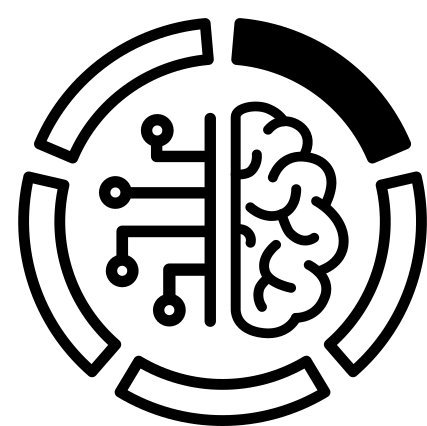
Level One
Human only, no AI tools were used. Some examples might be:
- A document written without an AI modifying, contributing, or even reviewing it
- Visual art created entirely "by hand", whether digital or not
- Software composed without AI coding assistance
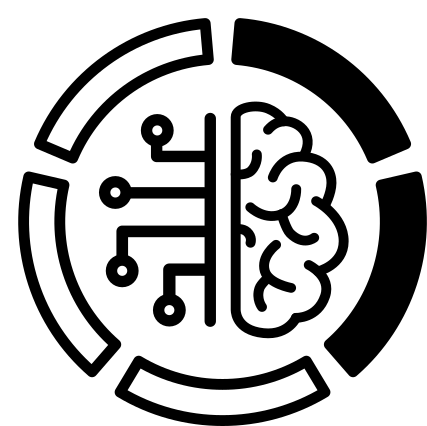
Level Two
Human directed, reviewed, and approved, with some AI tooling involved:
- Using an LLM to review a document for awkward wording or grammar and incorporating its suggestions into the document, or to assist with research
- Visual art that was created largely by hand, with AI tools being used to make relatively trivial adjustments that don't impact the creator's vision for the work
- Software composed using AI coding assistance to suggest general approaches to solving a problem, locate and correct defects, or complete small blocks of code
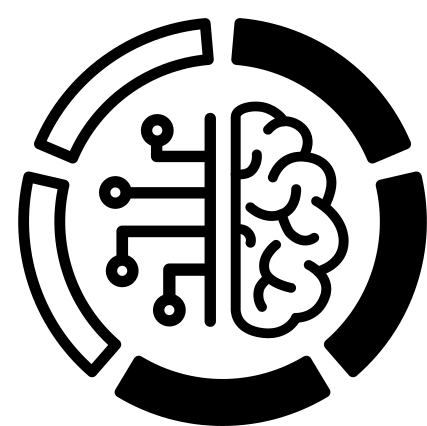
Level Three
Human directed, but incorporating a good number of AI-composed elements:
- A document that includes both human and AI-composed content, mostly directed by the creator, and fully reviewed by the creator before publishing
- Visual art that incorporates immediately visible elements generated with AI combined with human-created elements, but still largely represents the creator's overall vision for the work
- Software with architecture and design primarily human-directed, but with a good amount of code generated with AI coding assistance
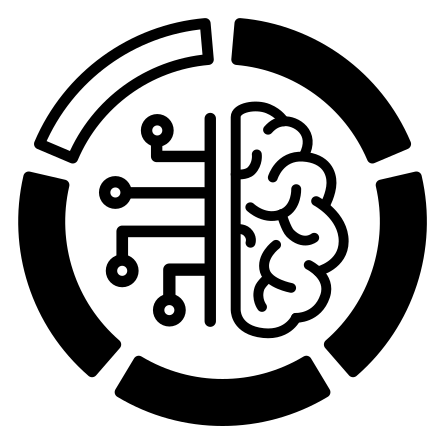
Level Four
Largely composed by AI, with some detailed direction or editing done by a human:
- A document that is composed of many sections that were generated with AI prompts, then stitched together and cleaned up by a human before publishing
- Visual art that was initially generated by AI, then altered either by hand, or using other AI editing tools, to better fit the artist's vision
- A software system composed of AI-generated code, that was then reviewed and tested by a skilled engineer (possibly using AI assistance) to verify its integrity
Level Five
Completely generated by AI using only basic high-level prompts from a human:
- A document written by an LLM using a prompt that identifies only the purpose and general content of the generated work
- A digital image or video constructed entirely from prompts, perhaps long and sophisticated ones, with the generated work being published with little or no additional editing
- A software system that was created, tested, and released with little to no direct human authoring or review of the code
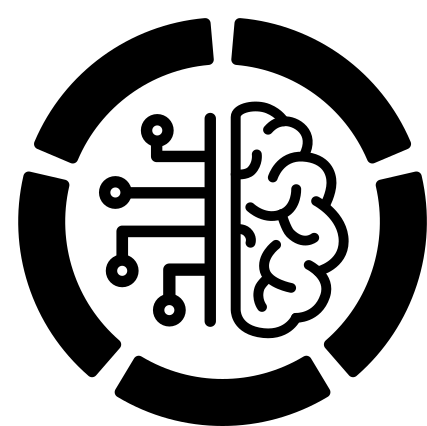
The icons above are designed to provide quick visual identification of these five levels. The segmented circle fills in a clockwise direction. The icon for Level One has a single segment filled in, directly over the human brain side, which will hopefully make it easier to remember which end of the scale represents the more human-oriented works. They are in SVG format, so they should scale cleanly, and can be converted to other formats easily. I've also envisioned simpler variants of these icons that would be better choices if they are scaled down to very small dimensions.
I acknowledge there is subjectivity in those level definitions, and I don't think that can be completely avoided. But given what I'm trying to accomplish with this idea, and the spirit behind how I want to see it applied, I don't think the subjectivity is a serious problem.
I've applied Creative Commons licenses to all the documentation I've created around this concept, as well as the graphics I've designed. I've constructed this such that nobody can directly capitalize on the idea, not even me. At least that's my hope. I don't have a YouTube channel or any sort of corporate sponsorship for this effort, and I'm not a particularly noteworthy personality in this field. I want to keep this invention pure and easy for anyone to use without being concerned about intellectual property issues or attribution.
What it is not (and should never be)
Firstly, the Fritz Scale isn't perfect. Even with five levels, there might be some situations that seem to fall between the cracks. A creator should use their best judgement to pick the level that best represents their work, to keep things quick and simple. They shouldn't call anything a "1.5" or "3.2", or maybe suggest that there's a level zero that's even less AI than no AI at all. (I'm not sure what a zero would even represent. Something that involved no computer or human in its creation? Maybe something in nature, like a tree or a rock?)
I'm not addressing a big question will naturally come up when discussing this scale: What even is "AI"? I don't think there is a strict definition of Artificial Intelligence, and I'm not sure there can be one, at least not one that is universally accepted. I'm not going to propose a definition for AI, and if I made such a definition a prerequisite for this scale concept, the scale might never exist. In keeping with the spirit of this whole idea, I'm going to assume that creators are going to use a good, reasonable idea of what AI is when assessing their own works.
Also, the scale is not intended to be a certification or guarantee. It assumes creators want to voluntarily disclose that AI was used to create their works, that creators are selecting the appropriate level themselves, and that creators are being truthful in their self-assessment of the level of AI involvement. This is very important to understand. People might be insincere in their self-assigned level. The scale is not intended to solve the problem of human dishonesty. I certainly don't want to see this scale used in any sort of paid certification service, because I see no way such a service could be much more "trustable" in practice than a creator's voluntary disclosure.
There are some tools out there than can assess the likely level involvement of AI for some specific types of works, and those tools can be useful. The spirit behind this scale is different. This is a tool to be used by people who do not intend to hide the use of AI in their works. It is a tool for honest disclosure so that the audience can know, and hopefully be comfortable with, the degree of AI involved with the work.
Finally, there are large aggregate works like videogames that involve many types of content like software, graphics, music, and voice acting. It would be pretty difficult to assign a single number to the degree of AI involved in the overall work when the levels for each component of the work might be different. And no one should use an average to summarize it, then all the important information is lost in the aggregation. I think, in these situations, if the creators wanted to use this scale, they could break out the different components of the larger work and assign a level to each.
Why it is named 'The Fritz Scale'
The name is short and easy to remember. Also, "Fritz" is my name. I named it after myself. I am a software engineer of 32 years by degree and trade, with a good deal of experience using AI assisted tooling for various tasks within my profession. I've also experimented with AI assisted content generation for other tasks, like prose writing and image/video generation. My work with AI didn't start with the recent explosion in the popularity and utility of LLMs. In fact, my very first job way back in 1993 involved creating AI-based solutions for the automotive industry. AI has been around a long time, it has always fascinated me, and it is a subject I've spent a good amount of time pondering over the last three decades. I submit that I am qualified to develop and refine this concept.
I could suggest that this naming is a clever way to acknowledge human vanity and the presence of the human element in a world that is producing and consuming an increasing amount of content involving AI. I feel like that is not an unreasonable thing to suggest. However, if this scale is adopted by a non-trivial number of people, and someday I see it being used in the wild, I'm sure it will put a huge smile on my human face. I'll take a selfie on that day and post it here.
What's the Fritz Scale of the Fritz Scale?
That's the spirit! Most of the concept came completely from my mind. I recognized the need, developed the idea, decided there should be five levels, and envisioned the design of the icon myself. I then used Claude Code CLI as an ideation tool to explore some of the details, produce examples, and generate a design document that lays out the concept a bit more formally than it is explained here. Thus the Fritz Scale of the Fritz Scale is "Two".
I could mention the icon itself as a work of graphic art. I explained to Claude Code how I wanted the icon to look using fairly detailed language, and asked it to produce an SVG for it. After a few attempts and refinements, this is the best it came up with: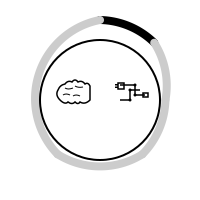
Maybe if I spent much more time on the prompt, or used tools better suited for the purpose, AI and I could have produced something much better. But I gave up at that point, and used a combination of tools I do know to create the icon entirely by hand. Thus, the icon is a "One".
Finally, this page itself is also a "One". I wrote it all myself. No LLM was involved in composing it, or ever reviewed it. It probably has some grammatical errors in it as a result. I'm not at all opposed to using AI to create or refine documentation, I just didn't feel like it was needed for this task. And I personally value having at least some of my human-to-human communication be entirely human. But that's the subject for another article.